The Expansion of UW – Madison
After joining the Union on May 29, 1848, Wisconsin’s first governor, Nelson Dewey, approved the founding of the University of Wisconsin. The first classes were held on February 5, 1849, in a temporary location near the state capitol. The initial curriculum focused on classical subjects such as history, mathematics, and literature. As the university developed, upperclassmen could elect more specialized courses, including law, chemistry, economics, and politics.
1850 – 1875
Over the next several decades, the university experienced significant growth, including expanded academic programs, new buildings, and the opening of the university to women. In 1851, North Hall opened as the first permanent campus building, serving as both classrooms and dormitories, followed shortly by the original Science Hall. In 1859, the iconic Bascom Hall opened its doors. While its foundation remains the same, the building has undergone several renovations over the years.
Fourteen years after the university’s founding, women were admitted into the Normal Department, which was later reorganized as the Female College. In 1874, John A. Bascom would close the Female College, and women officially received full coeducational status.
1875-1900
The establishment of the Scandinavian Studies Department in 1875 helped spearhead the creation of numerous academic departments during this period. Rapid enrollment growth in the late 19th century led to significant campus expansion. In 1883, the Pharmacy Department was established, later offering a four-year Bachelor of Science degree beginning in 1892. In 1877, the university received its first major gift from Cadwallader C. Washburn, which funded the construction of an observatory overlooking Lake Mendota. Legislation passed in 1889 formally established the colleges of Letters and Science, Mechanics and Engineering, Agriculture, and Law. Notable buildings from this era include the Armory-Gymnasium (now the Red Gym) on Langdon Street and the Victorian Gothic mansion that later became part of the Allen Centennial Garden.
1900 – 1950
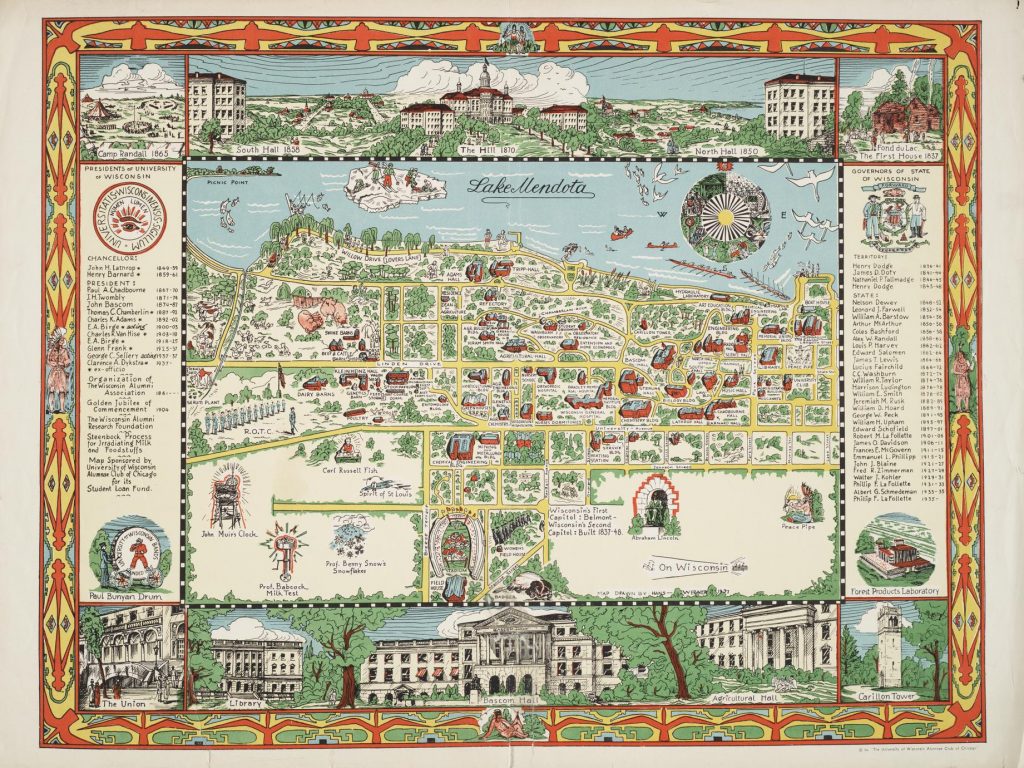
The early 20th century was marked by continued expansion and the creation of new schools and student spaces. The Wisconsin Union was founded in 1907, becoming the second college union in the nation, and later, in 1928, the Memorial Union building opened its doors. Several academic units were also established, including the Department of Agricultural Economics (1909), the School of Nursing (1924), the School of Education (1930), and the Department of Wildlife Management (1939).
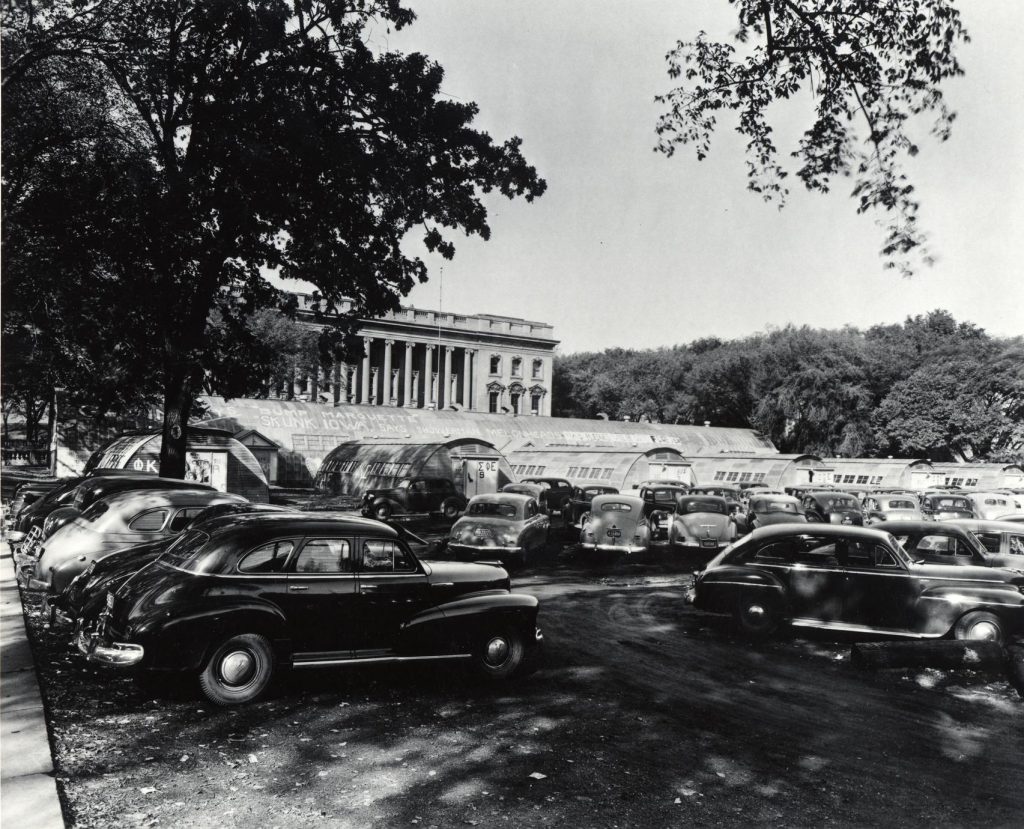
Following World War II, a wave of veterans returning caused university enrollment to nearly double between 1945 and 1946. To accommodate the rapid growth, the university constructed fifteen Quonset huts, mostly located on Library Mall. Although the huts were cold and poorly lit they helped relieve severe space shortages by serving as classrooms, laboratories, book storage, and reading rooms. By 1953, all but one hut had been sold; the final structure stood behind the School of Education on Bascom Hill until being demolished in 2004.
1950 – 2000
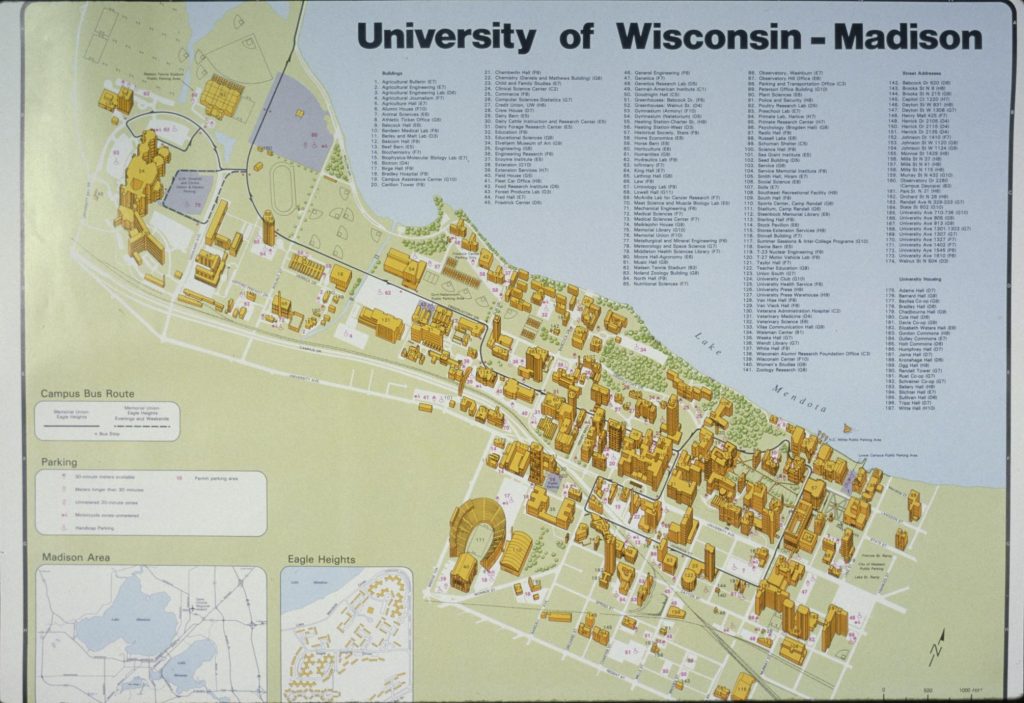
Postwar enrollment growth created an urgent need for additional housing and facilities, prompting the construction of several residence halls. Bradley Hall and Chadbourne Hall opened in 1959, followed by Sellery Hall in 1963 and Witte Hall in 1964. The high-rise construction boom of the late 1960s produced some of the tallest buildings on campus, including Van Hise Hall (19 stories, 234 feet), the Atmospheric and Oceanic Sciences Building (15 stories, 180 feet), and the Engineering Research Building (14 stories, 184 feet).
During this period, UW Health also expanded significantly with the opening of the 1.5-million-square-foot Clinical Science Center. This facility brought together UW Hospitals and Clinics, the UW Clinical Cancer Center, UW Children’s Hospital, and key clinical programs for the medical and nursing schools.